
As shown in the above photo, the present day Asoka pillar in Nepal is not the same as the other pillars.
This particular location is widely recognised as the birth place of Buddha, Sakyamuni.
This Asoka Pillar was discovered by Anton Führer. Anton Führer was sacked after admitting many acts of plagiarism. The Ashoka pillar he discovered is most likely a fake.
The Buddhists world over visit a temple complex known as the “Bodh Gaya” hoping to find the location where the Buddha attained enlightenment.
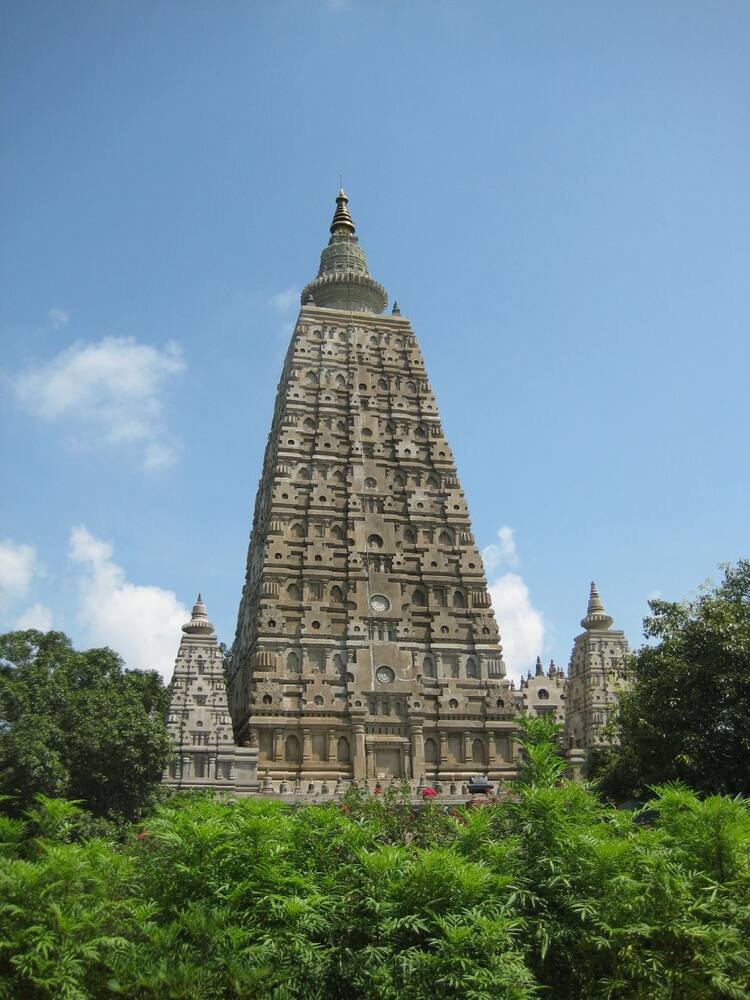
A closer examination will reveal the Bodh Gaya with a tall Shikhara is in fact a Hindu temple.
The entire area is like a Hollywood movie set that deceive thousands of innocent pilgrims on a daily basis.
That is the short version of the story.
Marco Polo, the 13th century explorer hints at a history far closer to reality in his memoirs above. Read the page in context here.
Marco Polo writes under the heading “Origin of the Buddhist Religion in Seilan” how Buddha was born and lived in the island of Sri Lanka.
The editorial comment on p.289 mention the following. “This is the well known island of Ceylon, both direction and distance are extremely correct”.
The rest of the story will reveal how the true history of both the Buddha and Ravana mentioned the Hindu epic The Ramayanaya was concealed from the world.
According to Buddhist scriptures the Buddha was born in part of an island known as “Jambudipa”. The equivalent Sinhala name is “Dambadiva”.
The venerable Sāriputta said to the monks: “The people of Jambudīpa are clever and with sharp faculties. Be they warriors, or brahmins, or householders, or recluses, they will certainly ask you: ‘What is the teaching given by your great teacher? With what instruction does he instruct you?’
https://suttacentral.net/sa108/en/analayo
A historical reference to the location of the Jambudīpa.
If the question was asked from ANYONE on the planet where Buddha was born he/she would say he was born in Sri Lanka. This was the case until the year 1890.
The Bible commentary shown above was printed BEFORE the Sri Lankan history was re-written. Further references from Sir Henry Charles and Robert Knox is attached below.
History of Ceylon (Robert Knox) - By Philalethes, A. M. Oxon. Published 1817
Sri Lanka was administered by the British when its history was obfuscated. A number of individuals got involved and turned the history upside down. The Birthplace of Buddha was changed to Nepal.
Dambadiva is 57-miles East of Colombo
Ceylon and the Cingalese- By Sir, Henry Charles, published in 1850 (Before the history was changed) . “Dambadiva” is the Sinhala translation of the Pali term Jambudipa. The Jambudipa is therefore 57 miles East of Colombo, the capital of Sri Lanka. This is the “Deva Area” in the map below.
The British re-write of Sri Lankan History
India was referred as "The Jewel in the British Crown" by the British. The amount of money it made and the level of prestige it gave to the British would have been a major factor.
The Royal Asiatic Society was formed in this background. The group had a political motive it seems even though outwardly it appears to be a forum with an interest in Asian history.
The following is written about Rhys Davids. Rhys Davids translates the Buddhist cannon to English,
Rhys Davids attempted to promote Theravada Buddhism and Pāli scholarship in Britain.Rhys Davids changes the entire history changing where Buddha lived from Sri Lanka to Nepal/Northern India when he translates the Pali Cannon to English. Rhys Davids is only one individual. There are others.
He actively lobbied the government (in co-operation with the Asiatic Society of Great Britain) to expand funding for the study of Indian languages and literature, using numerous arguments over how this might strengthen the British hold on India.
He gave "Historical Lectures" and wrote papers advancing a racial theory of a common "Aryan" ethnicity amongst the peoples of Britain, Sri Lanka, and the Buddha's own clan in ancient times.
These were comparable to the racial theories of Max Müller, but were used to a different purpose. Rhys Davids claimed that Britons had a natural, "racial" affinity with Buddhist doctrine. This part of Rhys Davids' career is controversial. (Source)
Alexander Cunningham, a military officer is made the archaeological surveyor to the government of India. It was Alexander Cunningham who turn a Hindu Temple into a site where Buddha supposedly attained enlightenment. Alexander Cunningham is later gifted a Knighthood for his career efforts.
Over 6000 ancient manuscripts along with the original Buddhist Pali cannon written in Sri Lanka have been taken to England. The manuscripts were taken home to England by George Turner and Hugh Nevill via France.
Some books may have been distributed or sold en route. Both these individuals worked for the British Civil Service.
A collection with the remainder of books are presently kept at the Manchester branch of the British Museum.
These documents emphatically prove Buddha was born in Sri Lanka. The British authorities are refusing to return any of these documents back to Sri Lanka.
in all fairness, the British keep producing a receipt of purchase for the manuscripts. However, the items have been purchased from dubious individuals that can only be described as treasure hunters.
The reality is that these documents belong to the people of Sri Lanka and require national consent when taking out of its jurisdiction. The Tripitaka is not for sale Just as the Magna Carta cannot be purchased for a few dollars.
Far more importantly taking away Buddhist manuscripts represents dishonouring of the treaty the British signed in Kandy.
Treaty Obligations
Sri Lanka was not conquered but administered under a treaty unlike most other countries in the Commonwealth.
The agreement between the island’s Chiefs and the British Crown is as follows.
The religion of Buddhism is declared inviolable and its rights to be maintained and protected.Although the Buddhist history has been distorted. The core religious manuscripts have been taken from the people of the island in violation of the treaty.
Kandyan Convention - Wikipedia
Major Errors in the Translation of the Tripitaka
The English translation of the Tripitaka is used by millions of people around the world.
The primary source used to produce the English translation is the Tripitaka taken from Sri Lanka.
North India is used as the background for the translation along with Sanskrit. The wrong country of origin introduces a large number of errors.
Furthermore, the Buddha himself admonishes against associating the teaching with Sanskrit.
Sanskrit when spoken produces tones that pleases the ear. This intoxicates and shifts the focus when the goal is escaping.
Rhys Davids dabbles in Sanskrit before translating the Pali cannon. More than 60% of the translation is influenced by Sanskrit words as a consequence.
The school kids in Sri Lanka learn Buddhism using a Tripitaka translation known as the Buddha Jayanthi. The Buddha Jayanthi is derived from the English translation along with all the flaws.
Generations of Sinhala children have been taught the Buddha was an Indian when he was in fact a Sinhala person just like them.
There is an established doctrinal rule that advise against word-to-word translation into any other language in order to prevent this exact problem.
The Tripiataka written more that 1000 years ago was never translated into other languages until it was translated into English violating doctrinal rules .
The Fake Pillar
The Askon Pillar that exist in present day Nepal is shown above. This pillar was discovered by Alois Anton Führer.
Who is Mr Fuhrer?
Führer's archaeological career ended in disgrace. Under official instructions from the Government of India, Führer was relieved of his positions, his papers seized and his offices inspected by Vincent Arthur Smith on 22 September 1898.The pillar allegedly “discovered” by Fuhrer is this.
Confronted by Smith about his archaeological publications and his report to the Government, Führer was obliged to admit "that every statement in it [the report] was absolutely false."
These activities were presaged by Führer's publications on Sanskrit texts and law which, as shown by Andrew Huxley, are effectively works of plagiarism, large portions being copied from the writing of Georg Bühler.
Alois Anton Führer - Wikipedia

Although what exists today is this.

The statement of Dr. Cunningham in his book ‘The Ancient Geography of India’ bears testimony to this: No trace of Kapila has yet been discovered at the foot of the Himalayas. After the recognition of these areas as the birth-place of Lord Buddha, only recently (within sixty years) these names are being used in the maps and official documents.Fuhrer’s charge sheet
And the noted historian Dr. Smith asserts that the place of the discovery of the Tarai inscription was never called Rummindei;it was a forged name given to it by archaeologist Dr. Fuhrer.The noted historian V.A.Smith challenges this statement of Dr. Fuhrer and comments – “This gives no further evidence for Fuhrer’s assertion and it appears that neither the Nepalese officials nor the hill-men called it Rumindei.” This was forgery of the name by Fuhrer in order to convert his discovery to a conclusion and to relate it with the name Lumbini.
Besides it has been proved that Buddhism had not been adopted in Nepal till the 6th century A.D.
Reference
Pilgrim Exploitation
The poor folks in Sri Lanka continue to visit India on pilgrimage often selling all they have.
MP Wijesiri said that most of the time it was the elderly citizens of this country, who went on pilgrimage to India and some of them did so after selling their properties.Sri Lanka’s Brahmin Culture
-MP Wijesiri complains of exploitation of Buddhist pilgrims
One of the most common questions raised is lack of Brahmin culture in Sri Lanka as mentioned in the Suttas.
An old rock inscription with a Brahmin reference can be found for example at Piyangala. The inscription describes a dwelling owned by the daughter of a Brahmin known as Baghyadatta.
When the Buddha emerged there were 64 different faiths in Sri Lanka. These included Veda teachings. Upon the emergence of the lord Buddha the entire island takes on his teachings.
Who is emperor Ashoka?
The name “Ashoka” emerge from ancient Sri Lankan chronicles.
Information about the life and reign of Ashoka primarily comes froma relatively small number of Buddhist sources. In particular, the SanskritAshokavadana ('Story of Ashoka'), written in the 2nd century, and the two Pāli chronicles of Sri Lanka (the Dipavamsa and Mahavamsa)What is not widely known is there were two Ashokas.
Ashoka - Wikipedia
The Chanda Ashoka is an Indian whilst Kala Ashoka lived in the island and belonged to the Ajasath and Bimsara royal lineage.
A translation error from the Pali chronicle has left out the “Kala” prefix. It was Kala Ashoka who conducted the Buddhist Councils and spread Buddhism to different parts of the world.
Kala Ashoka reigned in the Jambudipa or the Deva area of the island.
The role of of Chanda Ashoka in Sri Lanka is not yet clear and require further investigation.
How did the Buddha visit Lanka 3 times?
The island was divided into 4 areas that include the Yakka tribal region.
Ravana mentioned in the Ramayanaya for example was a Yakka or Yaksha in Sanskrit. Ravana was from this tribe and a citizen of Lanka.
The Alewaka Yakka mentioned in the Tripitaka and Kuweni Yakkshaniya of the Mahavansa also hail from this region.
The Mahavansa is indeed correct when it says the Buddha visited “Lanka” 3 times. The Buddha visited Lanka - the capital of Yakka area from the Deva area in the East.
The translators have taken literal meaning when describing the names of the 4 Siwu Hela tribes. Yakkas are described as “demons”, Nagas as “Snakes” and Devas are described as “Gods”. In reality these are ordinary human beings.
The Buddha attain Parinibbana at Kusinara. Vijaya whose reign currently marks the beginning of island’s conventional history begins the day after.
More -> Ancient Hela Diva, as explained by Aaataanaata Sutta and Maha Samaya Sutta
Speculative Reasons - Why/How?
It is quite bizarre - by re-configuring the history of the sub-continent the British have made Sri Lanka less important for Buddhists where it originated. Was Sri Lanka awake?
How come there is hardly a story in people’s recollection this happened? It is too early to fully explain how this was accomplished.
A conference held to discuss recent discoveries in Nepal may shed some light.
Memoirs of Chinese travellers such Faxian were used to re-construct the Buddhist history of Nepal.
Although “Jambudipa” error above is responsible for the mis-translation of Faxian’s accounts. Thus, the locations and distances assumed are incorrect.
The Buddha’s teaching barely survived due to various foreign invasions and natural disasters . The doctrine had to be re-instated from Burmese and Thai traditions.
Ancient Sri Lankan chronicles such as Mahavamasa were re-discovered quite recently in the 1800s.
The translation of ALL the Pali manuscripts including the Tripitaka were translated into English and German first.
The Sinhala version of the history was translated heavily influenced by secondary non-Pali material written by the British.
The real history is evident from the chronicles when viewed without considering the British translation.
Attempts to conceal the history of Ravana
Evidence is emerging indicating deliberate and wilful concealment of history. The Sigiriya was the castle fortress of Ravana.
Both Buddha and Ravana preceding widely known 2500 year history have been concealed. The motives aren’t clear however.
The authentic Buddha Dhamma is available NOW
The authentic Buddha Dhamma has re-emerged following the correcting of Sakyamuni’s history.
The Buddha teaching belongs to ALL of human kind. Therefore it is in the interest of all the correct history and teaching is preserved for the future generations.
The authentic and the resurrected Buddha Dhamma is available here in Sinhala for all to read and adopt in their lives.
Maghadhi spoken by Sakyamuni is the parent language of Sinhala. Learning of Sinhala language is recommended as a pre-requisite.
https://youtu.be/yd7mwVX-L_8
The post image is from brahminsexposed.wordpress.com

No comments:
Post a Comment